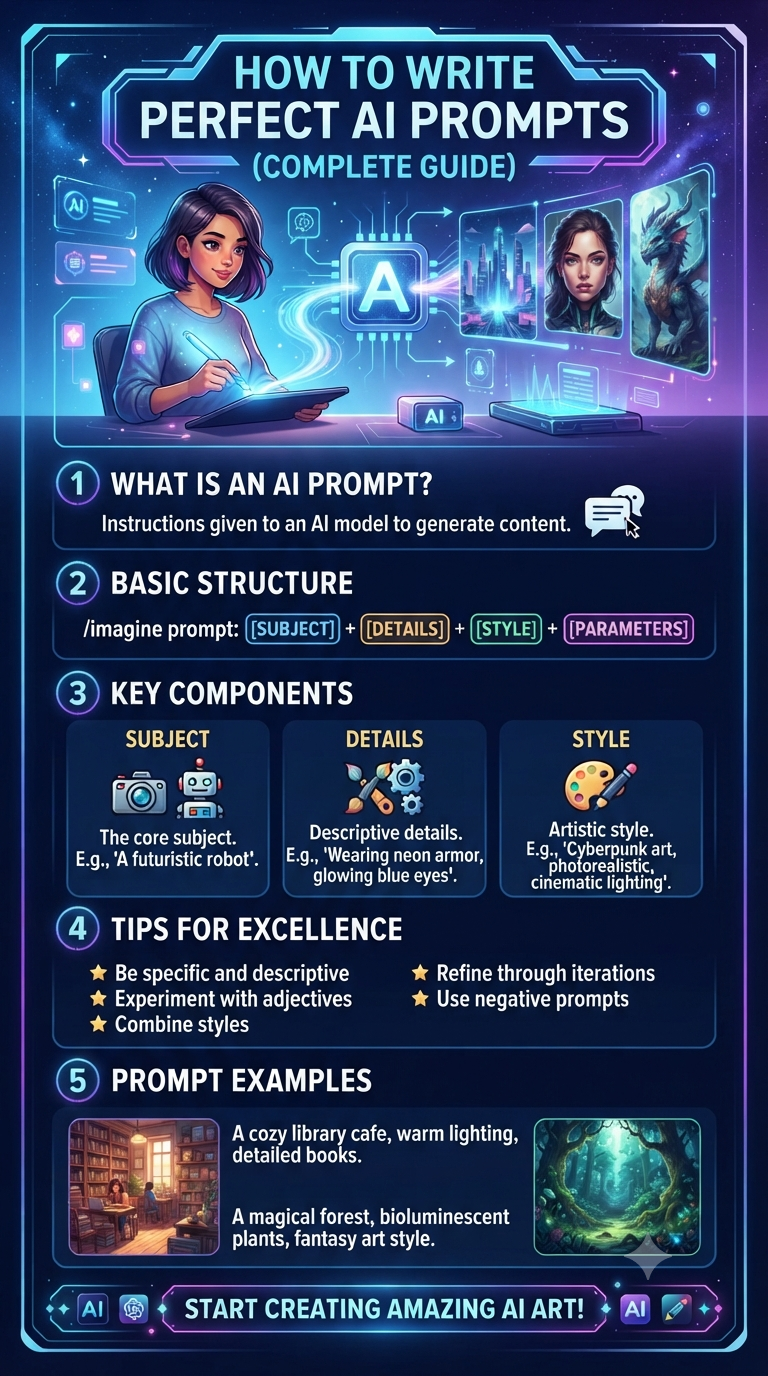
What Makes a Prompt 'Perfect'?
A perfect AI prompt isn't about magic words—it's about giving the AI enough context, clarity, and constraints to produce exactly what you need. The difference between a mediocre prompt and a perfect one is usually structure.
This guide covers the 6 components of a perfect prompt, common mistakes to avoid, and 10 prompt templates you can use immediately.
The 6 Components of a Perfect Prompt
1. Role
Tell the AI who it should be. This shapes vocabulary, tone, and expertise level.
Weak: 'Write about SEO.'
Strong: 'Act as an SEO strategist with 10 years of experience in B2B SaaS.'
2. Task
State exactly what you want. Use action verbs: write, analyze, compare, summarize, generate, rewrite.
Weak: 'Something about email marketing.'
Strong: 'Write a 500-word blog post section explaining 3 email marketing automation workflows.'
3. Context
Provide background the AI needs. Who's the audience? What's the goal? What's the format?
Weak: 'Write a product description.'
Strong: 'Write a product description for a noise-canceling headphone aimed at remote workers who take frequent video calls. Tone: professional but friendly. Length: 150 words.'
4. Format
Specify the output structure: bullet points, numbered list, table, paragraph, JSON, markdown.
Weak: 'Give me ideas.'
Strong: 'Give me 10 ideas in a numbered list. For each, include a title and a one-sentence description.'
5. Examples (Few-Shot)
Show the AI what good output looks like. This is one of the most powerful techniques.
Weak: 'Write a catchy headline.'
Strong: 'Write a catchy headline. Here are examples of the style I want: (1) '7 Ways to Double Your Traffic in 30 Days' (2) 'The Beginner's Guide to Email Automation' (3) 'Why Your SEO Strategy Isn't Working.'
6. Constraints
Set boundaries: word count, tone, things to avoid, reading level.
Weak: 'Write something.'
Strong: 'Write 200 words. Avoid jargon. Use a conversational tone. Don't use the word 'leverage.''
The Perfect Prompt Formula
Combine all 6 components into this structure:
[Role] + [Task] + [Context] + [Format] + [Examples] + [Constraints]
Example:
'Act as a copywriter specializing in SaaS landing pages [Role]. Write 5 headline options for a landing page promoting a project management tool [Task]. The target audience is small business owners who are overwhelmed by their current workflow [Context]. Present as a numbered list, each headline under 12 words [Format]. Here are examples of the style I like: 'Manage Projects Without the Chaos,' 'The Simplest Way to Get Your Team Aligned' [Examples]. Avoid buzzwords like 'synergy' and 'revolutionary' [Constraints].'
10 Common Prompt Mistakes
Mistake 1: Being Too Vague
'Write a blog post' gives the AI nothing to work with. Add topic, audience, length, and tone.
Mistake 2: Asking Multiple Questions at Once
Instead of 'What's the best CRM and how do I use it and what does it cost?', ask one question at a time or clearly number them.
Mistake 3: Not Specifying Format
If you want a table, say 'present as a table.' If you want bullet points, say 'use bullet points.'
Mistake 4: Assuming the AI Knows Your Context
The AI doesn't know your brand, audience, or goals unless you tell it.
Mistake 5: Ignoring Tone
'Professional,' 'conversational,' 'academic,' 'witty'—tone changes everything. Specify it.
Mistake 6: No Examples
Few-shot prompting (giving examples) dramatically improves output quality.
Mistake 7: Not Iterating
Your first prompt is a starting point. Refine based on output: 'Make it shorter,' 'Add more examples,' 'Change the tone.'
Mistake 8: Forgetting Constraints
Word count, reading level, words to avoid—constraints shape output.
Mistake 9: Using Politeness Over Clarity
'Could you please maybe write...' wastes tokens. Be direct: 'Write...'
Mistake 10: Not Testing Variations
Run the same prompt 3 times. Compare outputs. Refine the prompt based on what works.
10 Prompt Templates You Can Use Now
Template 1: Blog Post Draft
'Act as a [niche] writer. Write a [word count]-word blog post titled [title]. Audience: [audience]. Tone: [tone]. Include an intro, 5 sections with subheads, and a conclusion. End with a call to action.'
Template 2: Product Description
'Write a [word count]-word product description for [product]. Key features: [list]. Target customer: [description]. Tone: [tone]. Include a benefit-focused headline and 3 bullet points.'
Template 3: Email Sequence
'Write a 5-email welcome sequence for [business type]. Goal: [goal]. Each email should be under 150 words, include a subject line, and have one clear CTA.'
Template 4: Social Media Posts
'Generate 10 social media posts promoting [content]. Include variations for Twitter/X, LinkedIn, and Instagram. Each under 280 characters with 3 relevant hashtags.'
Template 5: Ad Copy
'Write 5 Facebook ad variations for [product]. Each includes a headline (under 40 chars), primary text (under 125 chars), and description (under 30 chars). Focus on [benefit].'
Template 6: SEO Meta Description
'Write 5 meta descriptions for [page title]. Each under 160 characters, includes [keyword], and compels clicks.'
Template 7: Summarization
'Summarize the following text in [number] bullet points. Focus on [topic]. Avoid jargon: [paste text]'
Template 8: Rewriting
'Rewrite the following text to be [tone] and [length]. Keep the meaning but [constraint]: [paste text]'
Template 9: Brainstorming
'Generate 20 ideas for [topic]. For each, include a title and one-sentence description. Prioritize [criteria].'
Template 10: Analysis
'Analyze the following [content type] for [criteria]. Identify strengths, weaknesses, and 3 specific improvements: [paste content]'
Advanced Techniques
Chain-of-Thought Prompting
Ask the AI to think step by step: 'Solve this problem step by step. Show your reasoning.'
Role Stacking
Combine roles: 'Act as both a copywriter and a data analyst.'
Self-Critique
Ask the AI to critique its own output: 'Review your response. Identify 3 weaknesses and rewrite.'
Temperature Control
For creative tasks, ask for 'unconventional' or 'surprising' output. For factual tasks, ask for 'precise' or 'conservative' output.
Final Thoughts
Perfect prompts are built, not found. Start with the formula, test variations, and refine based on output. The more specific you are, the better the result.
Get 100+ tested prompt templates at aipromptstock.com.
Comments (0)
Leave a Comment